How to Play Music from a NAS on iPhone
For a Synology NAS on iPhone, use Files over SMB if you only need to hear one track; use a dedicated player such as Trove Pro if you want to browse and play your music library from SMB or WebDAV. Trove's local-file playback is free; SMB and WebDAV network sources require the one-time Pro unlock. For offline CarPlay, first download the NAS songs into Trove's local library on the iPhone—CarPlay does not browse the NAS. You can also copy files to the phone and play them locally without Pro. Here are the setup steps, trade-offs and checks.
Why the Files app alone isn't enough
iOS can mount your NAS out of the box: Files → the ••• menu → Connect to Server → smb://192.168.1.x (or your NAS hostname), log in, and your music folders appear. Tap a track and it plays.
That's genuinely useful — and it stops being useful about two songs later. The Files app has no play queue worth the name, no album or artist browsing, no gapless playback, spotty background behavior on big files, and it renders your carefully tagged library as… a folder of file names. It's a file manager doing a music player's job as a favor.
Use it to check that the connection works. Don't try to live in it.
Route 1: quick listen over SMB in Files
- On the NAS, make sure SMB is enabled (on Synology: Control Panel → File Services → SMB; QNAP and TrueNAS have equivalents).
- On the iPhone: Files → ••• → Connect to Server → enter
smb://plus the NAS IP or name. - Sign in with a NAS account that can read your music share.
- Browse to a track and tap it.
Limitations, so you're not surprised: playback stops being seamless between tracks, some formats hand off to a bare-bones preview player, and streaming large lossless files this way can stutter while Files buffers.
Route 2: a music player that speaks NAS
If you got here by searching "play music from NAS on iPhone", this is the route that search actually wants: a player app that connects to the NAS itself. You add the server in the player, browse its folders, and play from the network; whether and how it indexes remote tags depends on the app and setup.
Two protocols matter here:
- SMB — the same share Files uses. Zero extra setup if the NAS already serves files on your LAN. Simplest for home Wi-Fi listening.
- WebDAV — runs over HTTP(S). Away from home, use a reachable HTTPS endpoint with a trusted certificate or a VPN; Synology QuickConnect is not a WebDAV endpoint. On Synology install the WebDAV Server package. See what WebDAV means for a music library and Synology's connection checklist before exposing a service.
What to demand from the app itself: both protocols, real format coverage (FLAC/ALAC at minimum — see how to play FLAC on iPhone), gapless playback, and caching so a dropped Wi-Fi frame doesn't kill the song.
The available players differ in library views, network protocols, offline behavior and pricing. If you're comparing cloud-oriented apps, our Evermusic and Flacbox comparisons document their sources and App Store prices. Check a candidate's current official feature list for the protocol you need instead of assuming every music player connects to a NAS.
Trove is our SwiftUI player for Mac, iPhone, iPad and Apple Watch. The free app plays local files; Trove Pro is a one-time purchase that unlocks direct SMB and WebDAV sources on Mac and iPhone/iPad. Add the server separately on each device if you use both: the shared NAS files are not an automatically synced local library. Download Trove from the App Store. The Apple Watch app plays music transferred to it offline with Pro; it does not browse or stream from a NAS.
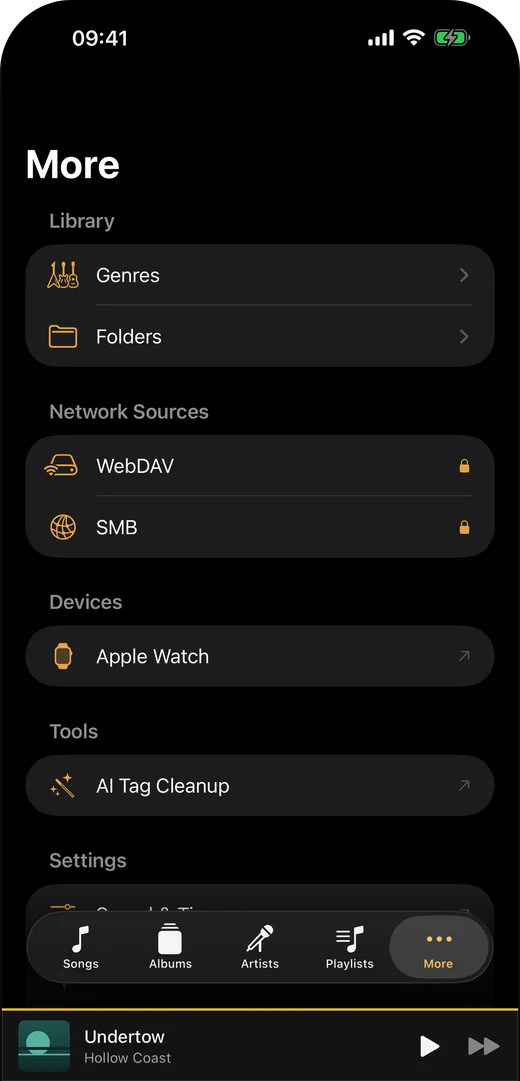
Synology + Trove on iPhone: SMB at home
These Trove labels come from the current iPhone app. The screenshot above shows the existing Network Sources entry; the steps below do not depend on an invented connection screen.
- In Synology DSM, open Control Panel → File Services → SMB, enable the SMB service, and confirm that the NAS user can read the shared folder containing your music. Synology's SMB setup guide documents the service path and share permissions. Keep the iPhone on the same local network for this first connection.
- Unlock Trove Pro if the SMB row is padlocked. On iPhone, open More → Network Sources → SMB, tap Add, and fill in the Add SMB form. Name is any label you recognize; Address (192.168.1.10) takes the NAS host or IP address without
smb://; Share name (e.g. Music) is the DSM shared-folder name, not/volume1/musicor a full file path. Enter Username and Password for the NAS account (or leave them blank only if you intentionally enabled guest access), then tap Save. - Open the saved SMB server and browse to the music folder. Tap a song to start network playback. A brief download for playback is not an offline copy: for a file you want to keep on the phone, use its Download to Library context-menu action. Inside a folder, Download All is available in the toolbar; confirm the downloads have finished and the songs appear in your local library before going offline.
On iPad, the same network entries are in the sidebar's Network Sources section rather than the iPhone's More tab. On Mac, Trove exposes network connection through the desktop menu/settings instead of the iPhone tab. The App Store listing and Pro entitlement are shared, but you still add the NAS connection on each device.
Optional: connect to Synology WebDAV
For a WebDAV setup, install and enable Synology's WebDAV Server package. Synology documents port 5006 for HTTPS (and 5005 for HTTP) in its connection guide. Prefer a trusted HTTPS certificate; do not expose an unencrypted NAS login to the internet.
In Trove Pro on iPhone, open More → Network Sources → WebDAV → Add. The Add WebDAV form asks for Address (https://…), for example https://your-nas.example:5006, and an optional Path (e.g. /music, optional) if you want to start at a particular shared folder. Enter Username and Password, use Test Connection, then Save. The app has an Allow self-signed certificate switch for a server you trust; do not use it to dismiss an unexpected certificate warning. Once connected, browse and tap a song, or use Download to Library / Download All for a true offline copy. Synology notes that QuickConnect addresses are not WebDAV endpoints; use a reachable IP or DNS name instead.
Route 3: skip streaming, sync the files
If your library fits on the phone (or a favorites subset does), copying files across and playing them locally is reliable on the subway or a flight. Trove's Download to Library is one way to make an explicit offline copy from a connected NAS; Wi-Fi transfer or Files import are free alternatives for files you already have elsewhere. The cost is curation: you maintain what's-on-the-phone. Temporary network prefetch alone is not an offline library.
Offline CarPlay: download NAS songs first
Trove's CarPlay view plays the iPhone's on-device music library, including songs explicitly downloaded from a NAS; it does not browse the NAS or keep a whole remote playlist offline automatically.
- While the iPhone can reach the NAS, connect the SMB or WebDAV source in Trove Pro using the steps above. The CarPlay interface itself is free.
- In Trove on the iPhone, use Download to Library on a song, or Download All inside a folder. A song temporarily fetched for network playback is not enough.
- Wait for the downloads to finish and confirm the songs appear in the local library. If practical, test one without network access before leaving.
- Connect to CarPlay and open Trove. Select the downloaded music under songs, albums, artists or playlists; CarPlay does not browse the NAS. If you prefer not to buy Pro, import the files into Trove locally via Files or Wi-Fi transfer instead.
NAS-side checklist before you blame the app
- Enable the protocol you plan to use (SMB service, or the WebDAV package — on Synology, WebDAV defaults to ports 5005/HTTP and 5006/HTTPS).
- Use HTTPS for WebDAV if you'll ever connect from outside your LAN.
- Create a read-only account for music playback — players don't need write access to your archive.
- Check the share name and path: Trove's SMB form wants the DSM shared-folder name, while WebDAV accepts an optional path. Neither wants a Synology filesystem path such as
/volume1/musicin the SMB Share name field. - On the phone, test one lossless track over your actual Wi-Fi before indexing a large library. Over cellular, check the app's caching behavior and your data plan before playing a Hi-Res folder.
If Trove shows Couldn't load, try Try Again after checking that the phone and NAS can reach one another, the SMB share name is exact, and the account can read that share. For WebDAV, run the form's Test Connection and read its failure message. Synology's WebDAV troubleshooting checklist covers service enablement, port 5006, account permissions, DNS/NAT loopback and certificate mismatch. A QuickConnect name is not a WebDAV address. Do not “fix” a remote connection by turning off HTTPS or broadly opening your NAS to the internet; use a correctly configured trusted endpoint or VPN.
Trove 1.6 improves SMB indexing after a permission-denied file: it continues past that file and lets you retry. That does not override NAS permissions or repair an unreachable share, so keep the checks above if a real server still fails.
FAQ: play music from a NAS on iPhone
Can the iPhone play FLAC from a NAS natively? The OS can decode FLAC, and Files will play one when tapped — but "natively like a music library" requires a player app. Full rundown: how to play FLAC on iPhone.
WebDAV or SMB — which should I use? On home Wi-Fi, SMB, because it's already on. For remote access, WebDAV over HTTPS is the cleaner, firewall-friendlier choice.
Does streaming from a NAS work over cellular? Technically yes via WebDAV (or a VPN back home). Practically, you want an app that caches aggressively, and a data plan that forgives lossless bitrates.
Do I need Plex or a media server? No — that's the point of WebDAV/SMB players: the NAS's plain file share is the server. Plex-style servers transcode and manage remotely at the cost of another moving part; for local music, direct file access is simpler and keeps your files untouched.
Does the same setup work on iPad and CarPlay? iPad: yes — the Files-app route and every WebDAV/SMB player route work identically there, and the bigger screen actually makes library browsing nicer. CarPlay: that depends on the player app exposing a CarPlay interface; the OS-level Files trick doesn't carry into the car, so check for CarPlay support when you pick your app. Also check what the car screen shows — a live view of the share, or only the songs you have already downloaded. Trove is the second kind: it has had CarPlay since version 1.2, free, and songs you download from the NAS appear in the car under playlists, albums, artists and songs, while browsing the share itself stays on the phone.
What format should the music on the NAS be in? Whatever you already have — that's the point of picking a capable player. FLAC is the common denominator for ripped collections; if yours is FLAC, see how to play FLAC on iPhone for the full format story, and FLAC vs ALAC if you're deciding what to rip into going forward.
Related guides & tools: WebDAV music player for iPhone and Mac (the protocol side, in depth) · Swinsian alternatives for Mac · Free in your browser: Album Art Finder · LRC Maker
Try Trove on your own library
Trove plays FLAC, ALAC, APE and DSD on Mac, iPhone and iPad. With Pro, those devices can browse a NAS over WebDAV or SMB. Apple Watch plays transferred songs offline, not from the NAS. Free to download; Pro is one $9.99 purchase across your devices.